A nurse’s continuing education transcript rarely shows up in the opening arguments of a malpractice case, but it belongs on the discovery checklist from the first week. Attorneys who pull it only after a deposition goes sideways are working from a weaker position than they need to. The record tells you what the nurse was supposed to know, when they were supposed to know it, and whether the hospital or facility gave them any reason to think otherwise.
This piece walks through what that record actually looks like, where to get it, and how to read it once you have it.
Why a Nurse’s CE History Can Make or Break a Standard-of-Care Argument
Standard-of-care arguments hinge on what a reasonably competent nurse in that specialty, at that time, should have known and done. Continuing education records are one of the few objective, dated, third-party documents that speak to what a nurse actually knew and when they learned it.
If a nurse administered a high-alert medication incorrectly, and their CE history shows no medication safety coursework in the three years prior, that gap supports an argument that the facility or the nurse failed to keep pace with required competencies. If the CE history shows the opposite, that the nurse completed relevant coursework recently and the error happened anyway, that shifts the inquiry toward systemic issues: staffing, protocol, equipment, or supervision.
Either direction, the CE record narrows the case. It tells you where to spend your expert budget and what questions to prioritize at deposition.
State Boards of Nursing: The Baseline Requirements Every Nurse Must Meet
Every state board of nursing sets its own continuing education requirements for license renewal, and the requirements vary enough that you cannot assume a nurse licensed in one state met the same obligations as a nurse licensed in a neighboring one. Some states require a set number of contact hours every renewal cycle, typically every two years. Others require no general CE at all and rely instead on employer-based competency checks. A handful mandate specific content, such as hours in pain management, infection control, or domestic violence recognition, tied to state legislation.
Before you look at any platform transcript, confirm the nurse’s state board requirements for the specific renewal period at issue. The board’s website will list the hour requirements and any mandated topics. This becomes your baseline: anything the nurse completed above and beyond it may be relevant to specialty competency, but the board minimum is the floor you’re measuring against first.

License verification through the state board also confirms whether the nurse’s license was active, lapsed, or under any disciplinary action at the time of the incident. That status check takes a few minutes and should happen before you spend time on anything else.
The Major CEU Platforms and What Kind of Records They Keep
Nurses complete continuing education through a mix of employer-provided training, independent CEU platforms, and professional association programs. Knowing which platforms are commonly used helps you know where to send a records request.
- Employer learning management systems (such as HealthStream, Relias, or a hospital’s internal LMS) track mandatory annual competencies: fire safety, HIPAA, blood-borne pathogens, and often unit-specific skills like IV insertion or ventilator management. These records are typically the most directly relevant to a malpractice claim because they show what the employer itself required and whether the nurse completed it on schedule.
- Independent CEU providers (such as CEUfast, Nurse.com, or Elite Learning) offer accredited courses nurses use to meet state board hour requirements. These platforms generate certificates of completion with dates, course titles, and accreditation numbers, and most retain transcripts for several years, sometimes longer if the nurse maintains an active account.
- Professional association education (through organizations like the American Association of Critical-Care Nurses or the Emergency Nurses Association) often ties directly into specialty certification maintenance and may carry more weight than generic CE because it is targeted to the nurse’s actual practice area.
Each of these sources keeps records differently, and retention policies differ by platform and by state. Some platforms purge inactive accounts after a period of years, which is one more reason to request these records early rather than waiting until closer to trial.
Specialty Certifications Like CCRN and CEN, and Why They Carry Extra Weight in Court
A general CE transcript shows that a nurse met a minimum requirement. A specialty certification, such as CCRN for critical care, CEN for emergency nursing, or CMSRN for medical-surgical nursing, shows something more specific: that the nurse voluntarily tested into and maintains a recognized standard of competency in the exact area where the alleged negligence occurred.
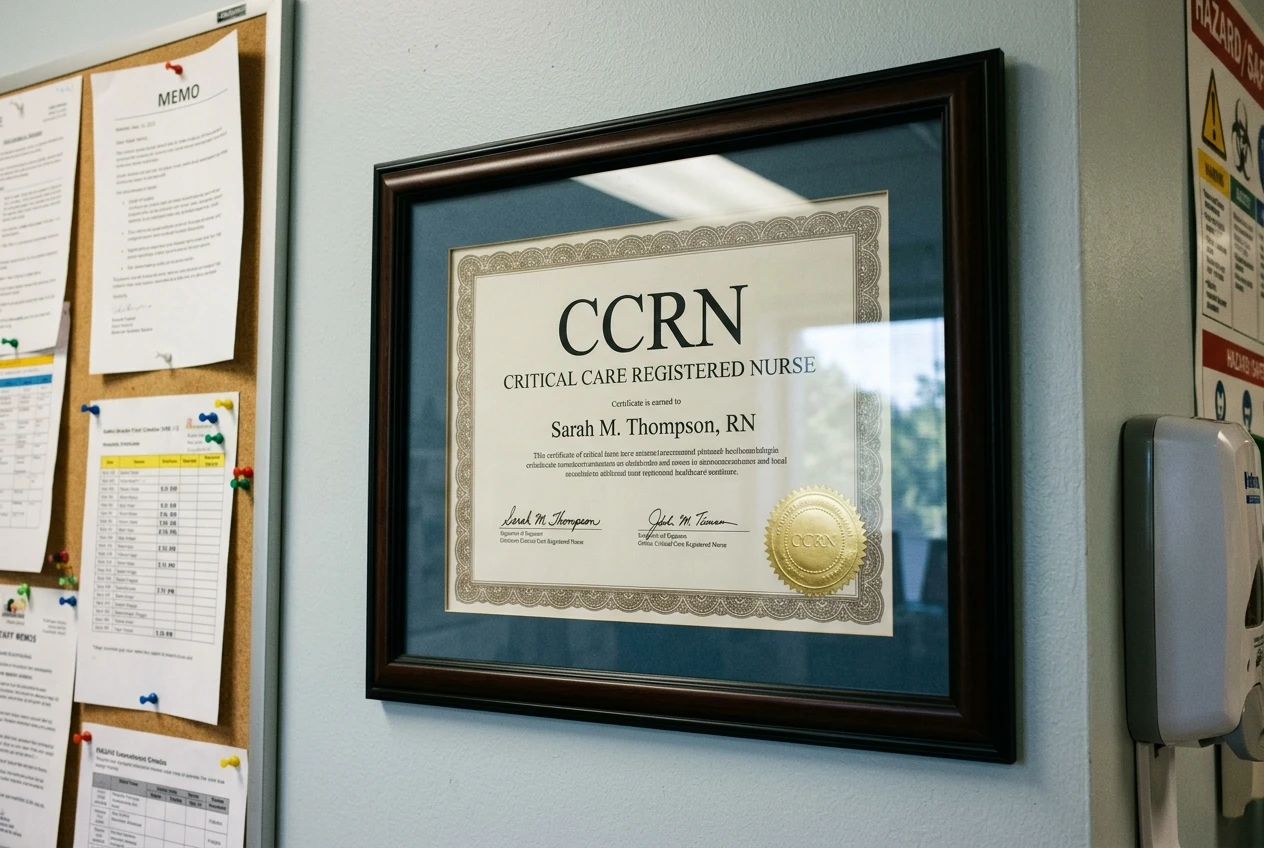
These certifications typically require a minimum number of practice hours in the specialty, a passing score on a standardized exam, and ongoing renewal through continuing education or re-examination. Because the bar for obtaining and maintaining them is higher than general licensure, courts and expert witnesses tend to treat them as meaningful evidence of competency, and a lapsed or never-obtained certification in a nurse’s stated specialty area is worth flagging.
If the nurse working a critical care unit never held a CCRN, that absence does not prove negligence by itself. Many excellent critical care nurses never pursue the certification. But paired with other gaps, it can support a broader picture of a nurse practicing above their verified competency level, which is a question worth putting to a standard-of-care expert.
Requesting CE and Certification Records During Discovery
The records you want typically live in three places: the state board of nursing (license status and any mandated CE filings), the employer’s human resources or education department (internal competency records and employment file), and the individual CEU or certification platform (course completions and exam results).
A subpoena duces tecum directed at the employer should specifically request orientation records, annual competency validations, and any CE the facility required or provided, not just a general personnel file. Personnel files are often incomplete when it comes to education records, because many facilities store training records separately from HR records. Name the training or learning management system by name if you know it, since that specificity speeds up the response and reduces the chance of an incomplete production.
For independent CEU platforms, a subpoena directed at the platform itself, or a records authorization signed by the nurse (sometimes obtainable through deposition or interrogatory), can produce a transcript showing every course completed, the date, and the accrediting body. Certification bodies like AACN Certification Corporation (for CCRN) or BCEN (for CEN) maintain their own verification systems and can confirm active status and renewal history on request.
Build the request language around specific document types rather than vague categories. “All continuing education transcripts, certificates of completion, and certification records for [nurse name] from [date range]” gets a cleaner production than a general request for training records.
Reading the Gaps: Lapsed Certifications, Expired CEUs, and What They Suggest
Once you have the records, the gaps matter as much as the completions. A few patterns worth flagging:
- A certification that expired and was never renewed, especially one directly tied to the unit or specialty where the incident occurred. This raises the question of whether the nurse was practicing at a level the facility itself had previously required.
- CE hours completed in a cluster right before a license renewal deadline, rather than spread across the cycle. This is common and not inherently damning, but it can suggest compliance-driven learning rather than ongoing competency maintenance, which is a fair line of questioning.
- A total absence of CE in the specific clinical area at issue, even when general CE requirements were met. A nurse can satisfy state board hours entirely through unrelated topics and still have no documented training in, say, wound care, if that happens to be where the alleged negligence occurred.
- Employer-required competencies marked incomplete or overdue at the time of the incident. This is often the strongest finding, because it shows the facility itself identified a training requirement and the nurse (or the facility) failed to close it out before the nurse was put back on the floor.
None of these findings stands alone as proof of negligence. They are context that either supports or weakens the standard-of-care argument your expert is building, and they give you specific, document-backed questions to ask at deposition instead of general ones the nurse can deflect.
Pairing CE Findings With Orientation Standards in Your Case File
CE history tells you what a nurse learned after they were hired. Orientation and onboarding records tell you what they were taught, or not taught, when they started. The two should be read together, because a facility with weak orientation standards and thin ongoing CE paints a more complete picture of systemic undertraining than either piece does alone. If you haven’t already reviewed how orientation standards factor into a negligence claim, new nurse orientation standards for malpractice cases walks through what to look for in that part of the file.
Between the two records, you should be able to answer a core question for your expert: did this nurse have the training the facility itself said was required, at the time the incident happened? That answer shapes the rest of the case strategy, from which experts you retain to how you frame the facility’s own responsibility.
If a nurse’s continuing education record raises questions you need answered before deposition, Nurse Becca Consulting can review the file and flag what matters for your case. Book a consultation through the Nurse Becca Consulting page.